Not Always As It Seems

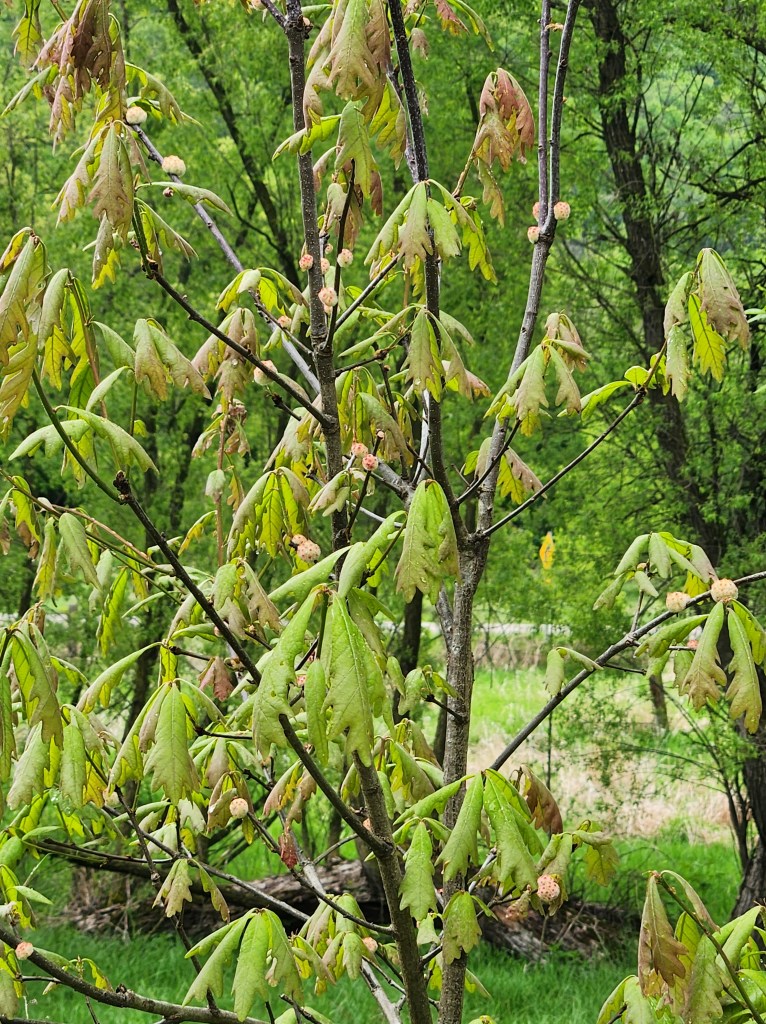
Have you noticed round growths on oak trees? I had seen them a few years ago, and looked them up and promptly forgot what I read. Now they’re reappearing and since we’re trained to be alarmed by the unusual, I began reading up on them again. It turns out most authorities agree they are harmless, just unsightly. But unsightly is enough for many people to seek ways to eradicate them.

Apparently, insects and mostly non stinging wasps lay their eggs on the tree and these balls, or more reverently known as galls, develop like a cocoon to protect and to feed the larva. Once the insects mature and fly the coop, the galls dry and drop from the tree. That is, if human beings can wait that long. Most articles state galls are harmless and then give numerous methods of removal. Some include pesticides.

As someone who’s not willing to sacrifice benefit for unsightly, I kept reading until I found a delightful article on these galls, of which there are many types. This article did not even hint at removal. In fact, it talked about the fun to be had with the galls once they drop. It even explained an interesting human use for the galls. It seems some clever wench about the 4th Century AD found a way to make ink from the gall, combining its acid with iron sulfate and gum Arabic. This amazing discovery was used in the writing of the first Bible and continued on to be used in the writing of the Declaration of Independence. Even the original United States Postal Service used it until replacing gall ink with chemicals.

What can be learned here? Let’s forego premature evaluation based on appearance and stop losing our collective memory to superficiality and looking good. Wisdom, it’s in our DNA. Dig a little.

Caring is an Art

I’ve begun to believe that caring is an art. At its best it’s born out of love. When we care for something, it’s not a selfless act. That’s a misconception we’ve been led to believe. When we care for something, we are extending our gratitude for its existence. 

I’m guessing in days gone by as we survived by what we grew in our gardens or harvested from the wilds, there was a lot more respect and caring for the land. I remember my Dine teacher saying before the Europeans came, no one would have ever thought to pee in the waterways. Let alone destroy the precious and life-giving water for personal gain.

For decades uranium mining on the Navajo reservation contaminated large portions of the water sources and led to kidney diseases and cancers. Today we’re faced with numerous attacks on our fresh water systems. The proposed natural gas plant, the Nemadji Trail Energy Center will be located in Superior, WI. Pipelines will run adjacent to or through waterways and spills are a given, not an exception.

Sign the petition to STOP NTEC. For non-superior residents, as well.

Today I spent time in our old heirloom orchard, cutting back grape vines choking the trees and nipping the early shoots of multi-floral rose. Multi-floral rose sounds like such a nice plant, doesn’t it? But I can tell you the thorns are ruthless as they cling to your clothing and gouge your skin. And nothing eats this plant, not sheep, not deer, no one wants it near-by. So, in an act of preservation of the land, I take to cutting it. 

Spring is coming early this year. Budding trees confirm this. Caring for the land is taking on a whole new urgency as the gratitude for all of it continues to grow.

Love as a Wake Up Call

The further we’ve removed ourselves from living naturally on the earth, the more the earth is challenging us to rethink our choices. And the choices keep coming. We’re over mid-way through this year and the natural disasters have increased worldwide. https://en.wikipedia.org/wiki/Category:2023_natural_disasters

So far we are in mitigation mode. We seek to reduce the severity and the painfulness of what is occurring. But mostly we rely on blind hope. We hope it is all an anomaly. We hope the facts are all wrong. We hope it doesn’t happen to us or at least not to anyone we love.

We hope our money holds out. We hope our air-conditioning does, too. We’re so busy keeping the ship afloat we seldom look to see how those around us are faring. 

Mitigation and hope will fail us. Sorry to be the bearer of bad news, but if you want to find solutions you have to step off the merry-go-round of distraction and roll up your sleeves.

If you are not growing some of your own food or helping others grow food, you are, minimally, out of step. If you are not seeking to reduce your consumption of energy – particularly of fossil fuels, you are a significant part of the problem. 

And if you’re not connecting with local partners to create local solutions, stop further pollution, and move towards renewables, you’re not even in the boat.

Get on board! Everyone can do SOMETHING.  Wake-up calls have come and gone. For me that call comes in the form of Love. Appreciation for the Earth and for one another gives me the courage to try. And clarity tells me all things are possible. 

A mega-transformation is needed. Let’s get on with it.

Shinrin-yoku

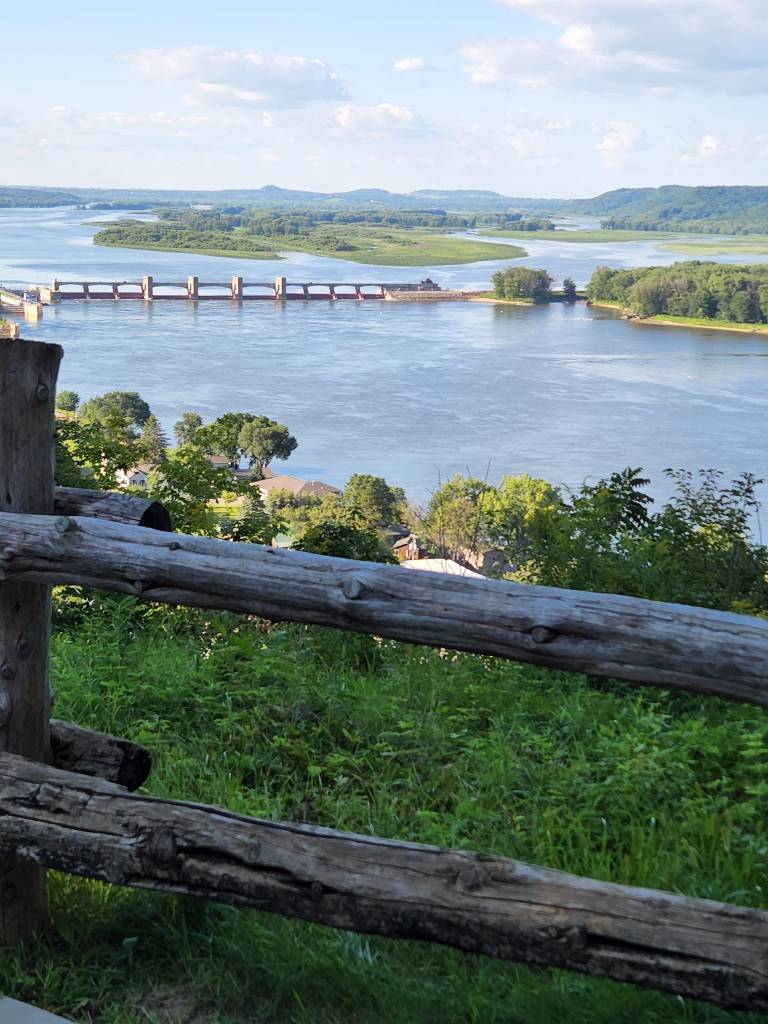
Took a drive to Iowa to hike the state parks around the Mississippi. Most of the land is overly manicured with the exception of abundant trees still standing in the parks. Immense mowed lawns and fields of corn leave most of the area treeless. Not understood is the significance of bio diversity, or of how trees clean the air and help prevent flooding.  They clearly have forgotten the wisdom of shinrin-yoku – the Japanese word for forest bathing. 

Don’t get your knickers in a twist, it doesn’t literally mean bathing. It refers to the process the human senses enjoy when in the company of trees. We shouldn’t require science to tell us we need to spend time soaking up Nature or reveling in a forest – but here we are. 

To many of us, trees are a commodity or a nuisance. Even as the earth struggles to breathe, we continue with greed and ignorance to destroy her. It is time to rethink the importance of trees.

I have fond childhood memories of the pine, apple and mulberry trees in our yard before my mother deemed them a problem and had them removed. Or the shock of learning of Chairman Mao’s “First Cutting”, the removal of China’s trees to hasten their industrial age. It took a bit of travel in Guangzhou to get to an island of trees left untouched. I still remember the feeling of ease walking among them. 

They say, “You can’t keep a man from making a living”. This is the cry of people who would have us believe the almighty dollar is more important than well-being.  It stems from an inherited belief in the right to harm. It is the same shortsightedness of ancient Easter Islanders and the calamity (which included rats) that brought a civilization to its end. 

We can do better.

The lead photo is from Maquoketa Caves State Park in Iowa

Nearby you will find the lovely Hurtsville Interpretive Center

And this photo of the Mississippi from Bellevue State Park

Loving Makes It Easy

The days keep growing longer. The birds, crickets and frogs break the silence with sweet sounds. The fireflies are back and their magic still enchants. Walking through the forest, the scents are a tonic, each plant offering its own special gift. The soil in the garden is a balm for feet and hands. Senses are heightened and gratitude comes easily. 

And I wonder why we ever took ourselves out of the garden.

If you look at your family history you’ll find it’s not been that long that our ancestors coexisted with the earth. It hasn’t been that long since they “made a way out of no way”. There is something so very basic in our relationship to the earth, so very integral. It’s in our blood. We are made of this earth and we return to this earth. It’s natural to appreciate it. It’s natural to learn from it and to celebrate it. What is unnatural is to do it harm. And this we have been doing for some time now.

From industry to industrial ag, from chemical herbicides to chemical fertilizers, this need to make our lives easier has made it a living hell. 

I’m always happy to hear of people trying to end the harm. Most recently a Canadian company, McCain Foods, asked their Wisconsin potato growers to adopt regenerative practices by 2030.  There are a growing number of voices both consumers and producers ready for change. 

And how hard will that change be to make? Loving makes the need for change come more easily. When we fall in love with the earth and all its wonders, when we appreciate the delicacies it offers and delight in our ability to co-create, we will change. Our health and the health of the planet depend on it. 

Oyster Mushrooms

In a year when the late spring frost crushed the apple blossoms and willful and cunning raccoons killed two broods of chicks, an abundance of oyster mushrooms is a welcomed gift.

Oyster Mushrooms

There on the dead tree the golden yellow glow of mushrooms keeps calling and offering up delicious treats. As in the immortal words of the Rolling Stones, “You can’t always get what you want but if you try sometimes, you might find… you get what you need.” 

Living on the land you learn to be accepting. A friend suggested it is stoic, but that word suggests indifference to pleasure or pain and that is not the pill I care to swallow. I never want to stop feeling the magnificent range of emotions granted us. But I do welcome the ability to surf the peace that lives beneath the tides of my emotions.

And then there are the golden oyster mushrooms. Succulent and almost sweet, they combine beautifully with nearly every meal. Like finding the first eggs of the season, or pulling up garlic or digging potatoes, there’s a familiarity and an excitement that can’t be denied. 

Liam getting ready to dry the mushrooms.

Those golden mushrooms signal a reminder that not all is lost, that among the dead and dying there is life and goodness. And when you ride the wave of acceptance and open your eyes so very much is given.

We live in a desperate time. We are ushered away from our inner solitude and are urged to chase illusive dreams of success. We’ve forgotten that being alive is the success. We’ve forgotten the earth is our garden of plenty. 

We have so much to remember…

Fortunately there are oyster mushrooms for those who have the eyes to see. 

Lauren loving the abundance…

What Nature Demands

Our chickens free range and not in a confined space. It means you’re likely to see chickens anywhere on the property. And of course that means every day is an egg hunt. We try to locate the nests before skunks, ‘possums or raccoons do. 

We were lucky to locate two sitting hens and move them to safe quarters. Seventeen chicks were born and pranced behind their fearless mothers.  Later a third hen yielded another six chicks. 

All seemed well until a predator unlocked the coop and killed all but one chick. Certain it was a raccoon; we set a live trap and ensured the third hen and her chicks were secure in another coop.

Next morning the trap was full of one extra large raccoon. But his audacity knew no bounds as he had ripped a board from the smaller coop and killed the hen and five of her chicks.

These are the times that challenge my desire to be peaceful. I’ve caught wild animals before, but none had demonstrated the strength and cunning of this big guy. And now we had to drive him away and set him free. 

His ferocity was intimidating, but the task was to free him and the hope was that he preferred his freedom to retaliation.

All ended well as he ran from the cage and scurried off.

We returned to find the solitary survivor chirping away, eager to live and to tell us all about it. We found two more nests in safe locations, so the chickens will do as they are meant to do and procreation will continue.

We’ll set traps for those who also do what their nature demands of them. 

And I will work hard to be true to our nature of love and compassion.

Right on Time


Here come the first hints of spring right on time. I heard a robin sing yesterday and today the call of the sand hill crane caught my attention. The snow is melting and the mud and the ice are treacherous if you take a wrong step, but the brilliant sun makes the cold wind cower and you know it is only a matter of time before you will walk barefoot again.

And there is hope, right on time.

The news in any given day is bleak and I am inclined to believe it is intentionally so. It is easier to control a population when it is kept on edge. It is easier to drive an agenda if you do not give people a chance to find their own way. But at the end of the day, it will always be our choice to fall for fear mongering and hate baiting or to strive to create sustainable peace.

Winter in the Driftless is not for those afraid of a good challenge. But it is the beauty of the season and the brilliance of the night skies that soothes the soul and holds the promise of spring.

I couldn’t live in a hopeless world. And the return of the sand hill crane reminds me of that. I muse over the latest news on the coronavirus, or the hatred that has reared its head against Muslims in Delhi. Yet I rejoice to hear the Korean woman tell how she survived the disease and how the Hindu man saved many Muslim neighbors making trips by motorcycle.

You see, spring returns. And with it hope. Not blind hope, but hope born of reason, conviction and action laced with integrity.  We are born for this. We are born to be victors over fear, hatred and ignorance, because we are born for love.


sandhill crane in flight courtesy of wikipedia commons

A Clarion Call

Ripples of fear can be heard in the voices of those reporting on the coronavirus. It is known that casual contact may spread the disease and that the incubation period may be as long as fourteen days prior to symptoms.

The admission, that Wuhan city officials were slow to provide information as they waited for higher authority, created distrust. People can be heard calling reassurances to one another from their quarantined homes in that city.

This information comes as the virus continues unchecked, causing people to feel victimized and paranoid. But even as the numbers of infected rise and the death toll climbs, there is more than fear that we need to heed.

Traditional medicine tells us we can maintain good and upright health through simple means. Beneficial sleep, good eating, clean water, maintaining our bodies through gentle movement and focusing our minds on good thoughts and emotions all promote health. Feeling our breath and allowing our lungs to fully expand and contract is important in relieving stress and in revitalizing our bodies and our spirit. And while this may not keep a virus at bay, it may provide the strength needed to overcome disease.

This is what individuals can do, but more is needed to live collectively as citizens of a healthy world. We are being asked to look at every aspect of our lives and the choices we have made. The virus mutated from wild animals, which were being sold in a Wuhan market. It jumped from animal to human and now is spreading from human to human with little impediment.  Our consumptive and exploitive attitude towards the natural world is causing our animal relatives great harm.  That harm now endangers us, and will continue, until we remember and live in a symbiotic way with all of life.

A clarion call has come.*


*a strongly expressed demand or request for action is a clarion call.


Revolution of Understanding

I have had the good fortune to visit Australia a few times. I deeply appreciated the beauty, the wildlife, the kindness of the people and the bits of aboriginal wisdom that I gleaned. The fires consuming much of that continent are leaving behind horrific loss. The efforts to save the animals are heroic and inspiring, but the sorrow is palpable.

Last year’s fires in the Amazon were attributed to agribusiness and the unwillingness of people to consider the consequences of such catastrophic change. Indigenous leaders are assassinated routinely as they desperately inform us of the folly of over consumption.

The media rarely tells their story.

Or are we simply too busy maintaining unsustainable lifestyles to care?

The unprecedented flooding of Jakarta is mostly ignored, as has been Puerto Rico’s never ending quakes. Compassion, once a revered trait, now takes a second seat to costs and profits. But, no worries, we have unlimited finances when war and oil are the concerns.

In the debate over climate change we have lost a lot of time. Corporate advertising and political lobbyists have successfully lulled too many into a stupor. The President and Congress are eliminating laws that protect our water, air and public lands – and giving corporate greed even more incentive to destroy the earth.

What will it take to turn it around?

A while back I heard the phase “revolution of understanding”,* and I have concluded that yes, if we are to find a way through this nightmare, it will take tremendous understanding. It will take the understanding that we are one people and one planet.  It will require vision and courage to make the choices that could have been made long ago.

Most importantly it will demand our love; the fiery kind of powerful love that refuses anything less. We can do this.


  • “Revolution of understanding” is a phrase I heard from Prem Rawat, a human being whose conviction towards living helps others to walk their own walk. And I for one am grateful.